
At the crossroads of the South Pacific, Fiji is a nation of lush, colourful settings and locals whose warmth knows no bounds.
I was expecting to spend most of my time in Fiji, a nation of more than 300 islands, on or in the water, but I’d mostly been thinking of the ocean.
Yet, on a warm morning in May, I found myself deep within the mountainous interior of Fiji’s largest island, Viti Levu, roaring in a red jet boat down a winding, mud-brown river, past sheer cliffs, dense jungle, and gentle banks where locals watered their horses or fished for tilapia or mud crabs.
The river was one of Viti Levu’s longest, the Sigatoka, whose fertile, farmable banks are known as Fiji’s “salad bowl.”
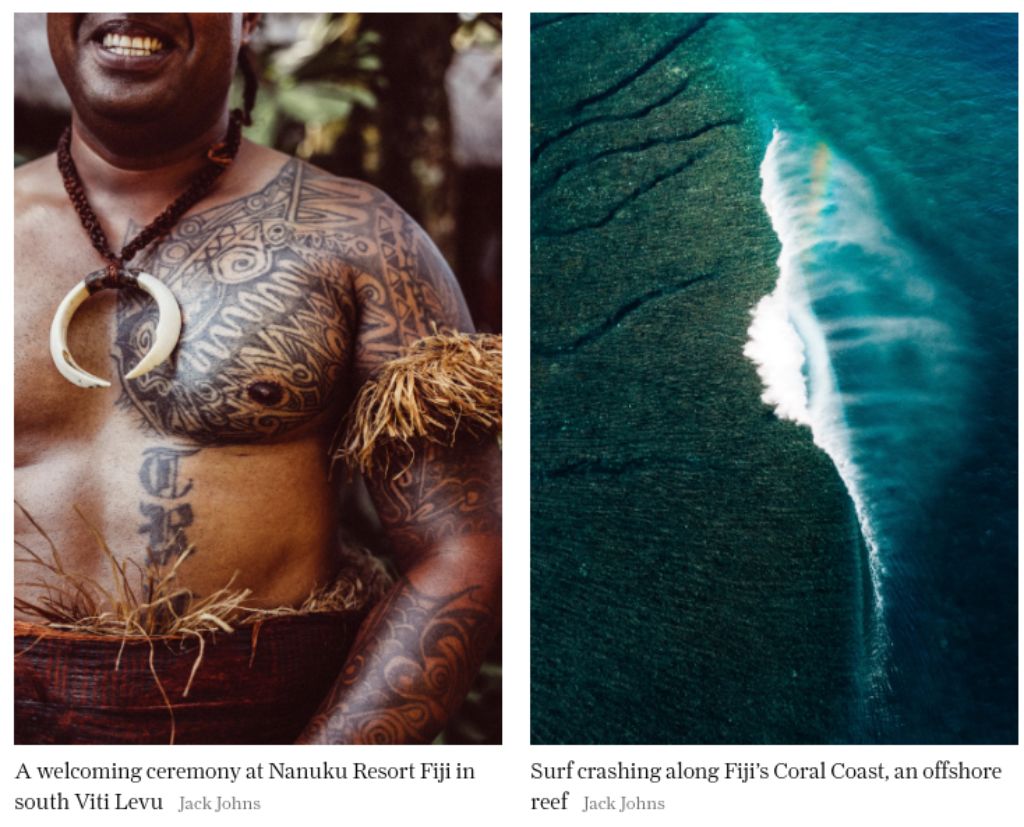
After a while, the boat driver, an Indigenous Fijian who introduced himself as Captain Nox, steered us into some shaded shallows and cut the engine to tell his 14 passengers a story.
Missionaries and reverends, back when the nation was first ruled by the British, in the late 1800s, met their violent deaths along these riverbanks at the hands of the island’s tribal members, at times for committing acts of tabu (or taboo, as Captain James Cook imported the word to English in 1777) like touching people’s heads.
“Fiji was the worst cannibal island,” Nox said. “But now Fiji is the friendliest island, eh?”
It’s true; nothing compares to the plosive enthusiasm of the Fijian greeting: “Bula!” It’s a word that floats like a bubble.
Everyone says “Bula!” to everyone, even passing strangers. And historically, many have passed through here.
A crossroads in the heart of the South Pacific, Fiji spans from eastern Melanesia, the region populated in prehistory by ethnically African people, into the western edge of Polynesia, which was inhabited later, by people who migrated from Southeast Asia by outrigger and double-hulled canoe.
A little more than half of Fiji’s 900,000 people are Indigenous, or iTaukei, and nearly 40 percent are ethnically Indian, descended from indentured laborers brought to work on sugar plantations during the British colonial rule.
Captain Nox steered the jet boat back out into the middle of the placid Sigatoka, and we roared off. We were now on our way to the village (1 of the 17 this excursion visits), and someone asked—due diligence—what tabus we should know about.
All the women had been given sarongs to wrap modestly around their waists, so there was that. And still no head touching, Nox said, and no hats.
But things seem to have relaxed since the day of those ill-fated colonialists because as soon as we arrived in the village of Mavua, our guide, a local who said to call him Jerry, told us we could leave our hats on. “It’s okay,” he said. “It’s hot today.”
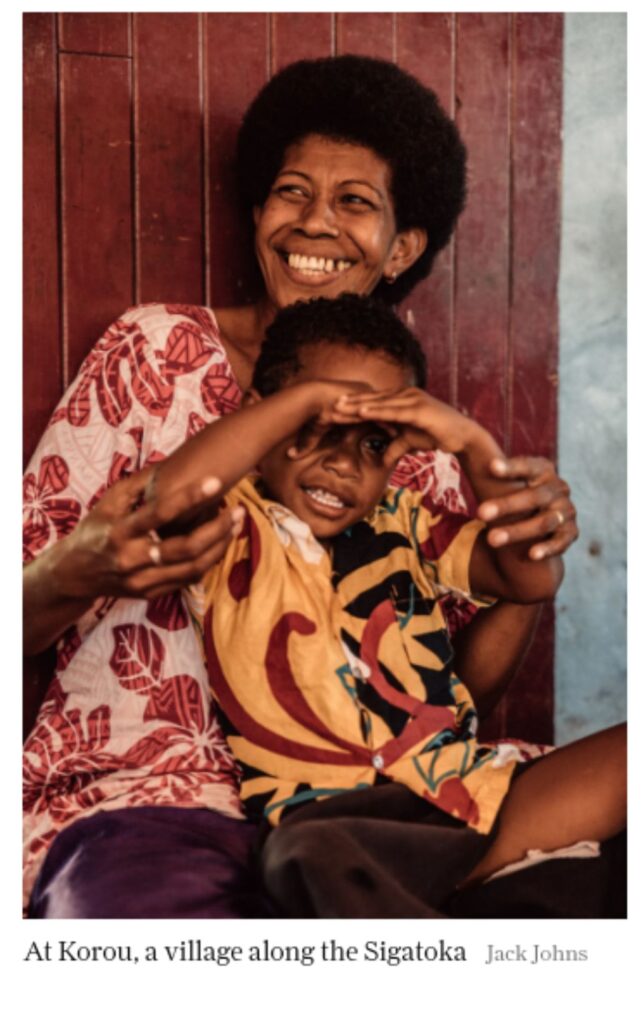
Mavua is a humble place, typical of a rural iTaukei village: a few dozen brightly painted cement houses with corrugated roofs, a church, a community hall, and roaming chickens and children. Its residents are mostly subsistence farmers.
On the weekends, women take surplus produce to local markets to sell, while the men hunt for wild pigs using dogs and spears. “We are trying to live in the life of our forefathers,” Jerry said.
In the community hall, a big, open-raftered room with louvered windows, 30 villagers welcomed us with a kava ceremony.
Beloved throughout the South Pacific, kava is an earthy-tasting, sediment-forward brown beverage made from the macerated root of a shrub in the pepper family (black, not bell pepper) called yaqona.
On first sip, kava makes your tongue go a little numb, and if you keep drinking, it induces a state of mellow good vibes.
Drink enough of it, and you may find yourself more or less immobilised.
Fijians are passionate about kava, which they call grog, and the slo-mo communal act of drinking it has long served as a tool for forging relationships and mitigating disputes.
As the kava was prepared, the village chief and the oldest man in our jet boat (by default, our chief) engaged in a ritualised dialogue, punctuated by clapping and eventual sipping.
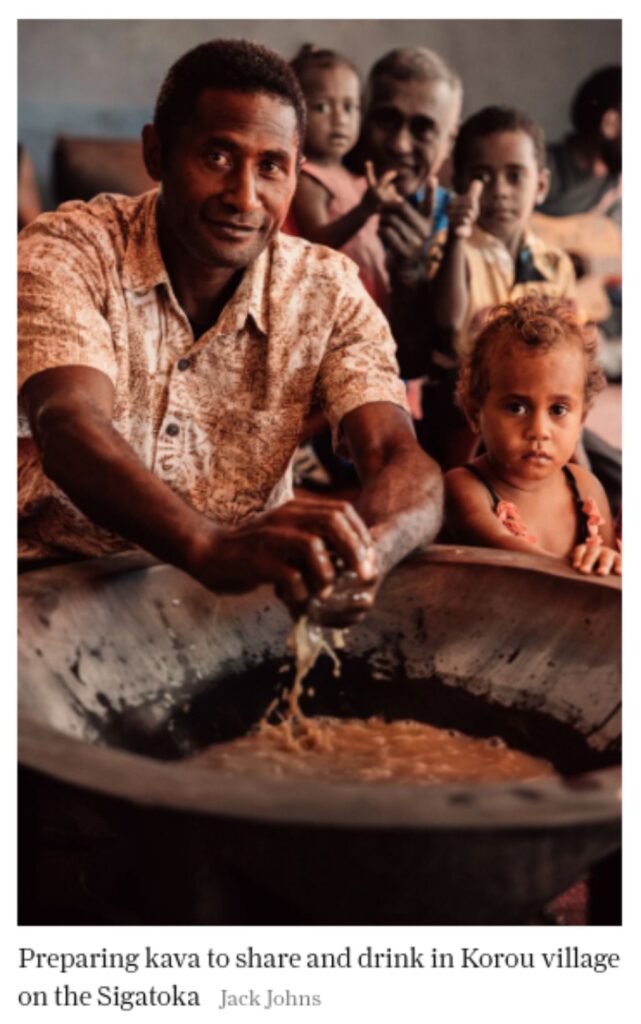
As the bilos—cups for drinking kava—were passed around, a heavy rain fell, drumming on the roof.
Women in brightly printed dresses draped us with salusalu, or leaf garlands.
The village dogs, drawn by the smell of lunch, waited hopefully outside the open doors. Sitting in long rows on the floor, we ate cassava and banana, greens, roti bread, sweet fried bread, ramen with curry sauce, chicken.
Afterward, while men played guitars and ukuleles, everyone danced together, shuffling back and forth across the hall side by side with arms around one another’s waists, laughing and sweating, and then we jet-boated away in driving rain, engine growling ferociously as Captain Nox spun us in circles.
One day I went out snorkelling at Nanuku’s teensy private island with Kelly-Dawn Bentley, a native of nearby Pacific Harbour and the resort’s resident marine biologist.
We glided over a reef in water so shallow I barely dared move my fins.
Little black reef fish bustled out of the coral as though to shoo us away.
A school of silvery thumbprint emperors flashed around us like a swarm of UFOs.
Kelly-Dawn explained that a familiar practice was being used to conserve Fiji’s aquatic resources.
“We are working with the local chief to hopefully designate this area as tabu,” she said, gesturing at the water between us and a nearby outlying island.
Throughout the South Pacific, tabu is a sacred prohibition that, traditionally, wasn’t used only to forbid offensive behaviours but also to manage community resources.
For example, if a chief decided a mountain had been too heavily hunted for pigs, he might declare it tabu until the pigs had time to recover. After overfishing in Fiji reached crisis levels in the ’90s, communities banded together to resurrect the practice of designating reefs as tabu so that fish could breed and mature in peace. The system is not perfectly effective (enforcement is a problem), but it’s an intriguingly modern application of an ancient idea. “Sustainability isn’t just environment,” Kelly-Dawn told me. “It’s socioeconomic, cultural, and environmental.”
https://www.cntraveller.in/story/the-wild-interiors-cerulean-blues-and-winding-rivers-of-fiji/
BY MAGGIE SHIPSTEAD
6 October 2023

You must be logged in to post a comment.